

When the Sky Begins to Speak: Kali Yuga End 2025 and the Decade Ahead

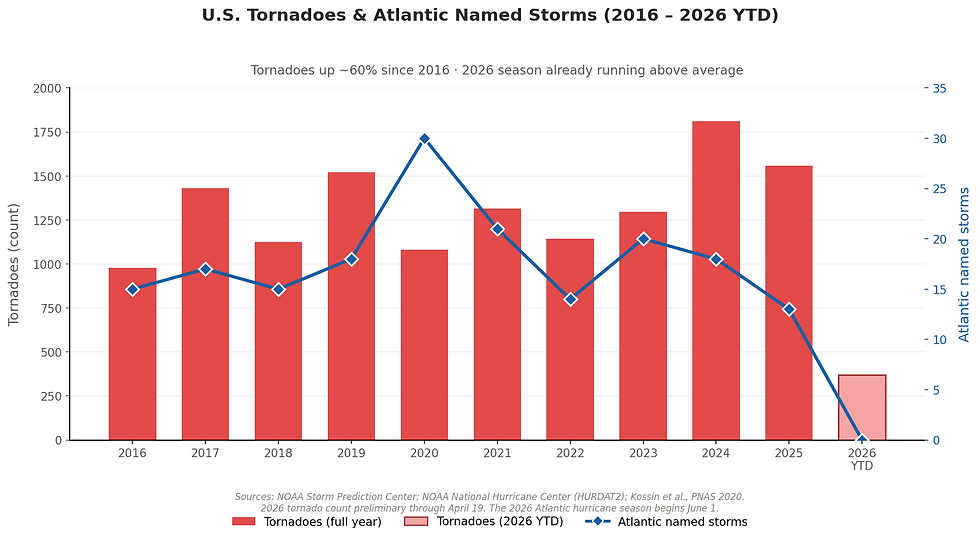
On March 15, 2026, a tornado carved through Wells County, Indiana with winds past 200 mph - an EF5, only the second in the United States in thirteen years. That same month logged 204 tornadoes, nearly triple the average. In 2025, America recorded 1,559 tornadoes — the second-highest annual total ever. In 2024, 1,811. The numbers have risen roughly 60% since 2016. In the North Atlantic, the probability of a storm reaching major hurricane strength has been climbing ~49% per decade since 1979 (Kossin et al., PNAS, 2020). Something is happening. And not quietly.

The ancient texts had a word for this. In Sanskrit tradition, the closing of an age is called Ekpyrosis — the fire of purification. Not punishment. Correction. The independent researcher Bibhu Dev Misra, in his book Yuga Shift, places the end of the Kali Yuga — our age of greed and forgetting — in 2025, calculated against the 25,800-year precession cycle of the Earth. From 2025 through the 2040s, he writes, humanity enters a transitional window in which that we have taken is likely to be returned to us, in forms we will call disasters, but which older cultures would have called arithmetic.
Uncannily, the scientific literature is pointing at the same window. A 2022 Science paper led by David Armstrong McKay identified sixteen climate tipping points — thresholds beyond which Earth's systems begin to shift on their own, regardless of what humans do next. Five are already in the "possible" zone at today's 1.2°C of warming. At 1.5°C — likely in the early 2030s — four more become likely: collapse of the Greenland and West Antarctic ice sheets, widespread permafrost thaw, coral reef die-off. The IPCC's Sixth Assessment projects that tornado activity will continue shifting eastward into the populated Southeast through the 2030s. Neither paper mentions yugas. Neither needs to.
What the old wisdom was actually saying
The Bhagavad Gita names lobha, greed — as one of the three gates of self-destruction. The Yoga Sutras place aparigraha, non-possessiveness, among the five ethical foundations of a conscious life. The Isha Upanishad opens with a single stunning instruction: tena tyaktena bhunjithah — enjoy through renunciation, take only what you need. These are not commandments from the sky. They are the observations of people who had watched civilizations rise and fall and understood that the line separating prosperity from collapse runs not through our economies but through our character.
We live in an age that measures worth by accumulation, status by consumption, and success by how loudly we can announce our lives — the grand parties, the curated social circles, the constant performance of having arrived. The earth, under this arrangement, is not a mother but a warehouse. The scriptures warned that such a civilization becomes top-heavy and eventually topples — not because any god is angry, but because imbalance, sustained long enough, becomes its own undoing.
The Invitation
If the sky is speaking, it is not asking for fear. It is asking for something much harder: simplicity in place of excess, humility in place of entitlement, humbleness in place of spectacle, genuine care in place of performance. Less consumption. More attention. Less noise. More honesty.
Misra's timeline and the tipping-point papers both suggest we have a window — narrow, but open — to recalibrate before the correction becomes a collapse. Ancient wisdom and modern data are, for once, pointing at the same horizon. The question is no longer whether to listen.
It is whether we remember how.
Sources: Misra, B.D. Yuga Shift (book) · Armstrong McKay et al., Science (2022) · Kossin et al., PNAS (2020) · IPCC AR6 WG1 (2021) · NOAA Storm Prediction Center · NOAA National Hurricane Center.
Spirituality & philosophy: #KaliYuga #YugaShift #VedicWisdom #Dharma #Aparigraha #Spirituality #AncientWisdom #Upanishads #BhagavadGita #HinduPhilosophy #Sanatana
Climate & science: #ClimateChange #ClimateCrisis #TippingPoints #ClimateAction #ExtremeWeather #GlobalWarming #ClimateScience
Lifestyle & values: #Simplicity #MinimalistLiving #ConsciousLiving #SustainableLiving #Mindfulness #SlowLiving #Humility #LessIsMore


Comments